
What the South Carolina Law Enforcement Division (SLED), Criminal Justice Information Services (CJIS) Is
The South Carolina Law Enforcement Division is an independent statewide law-enforcement agency. Its CJIS operation serves as South Carolina's central identification and criminal-history repository. Title 23, Chapter 3 gives SLED fingerprint, identification, criminal-information, and dissemination duties. Section 23-3-1010 also makes SLED the state's criminal-history compact repository.
CJIS does more than sell reports. Its Automated Fingerprint Identification System, or AFIS, anchors identity to prints. The Computerized Criminal History system, or CCH, joins identity, arrest, court, and custody data. Public Dissemination supports CATCH. Other units manage expungement processing, the sex offender registry, and incident-based crime data. Systems such as SCIEx and NCIC serve authorized justice users and are not public search products.
The official CJIS description shows these linked roles. Review the SLED CJIS unit source for the agency's current structure.
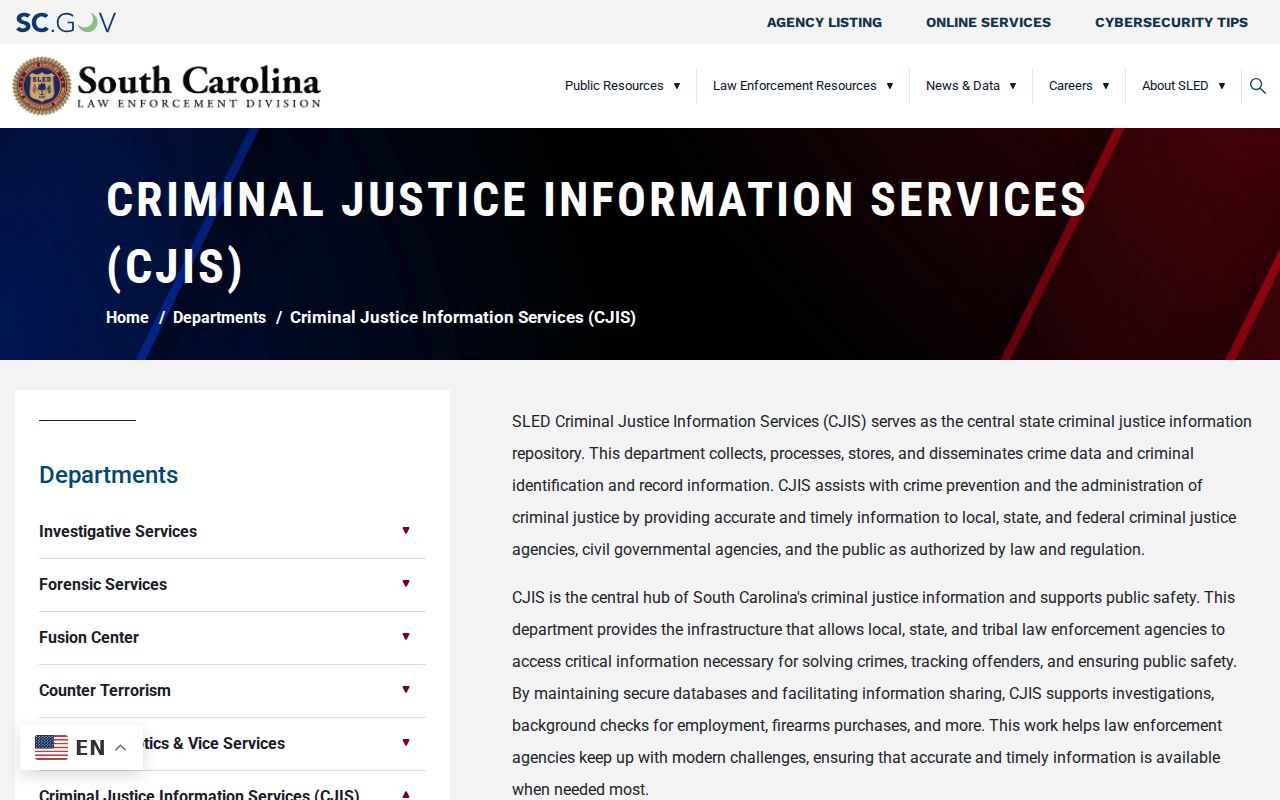
The CJIS unit view helps separate the public report, fingerprint file, registry, expungement, and crime-statistics functions.
SLED Criminal Records Since 1935
SLED's official history dates its creation to May 14, 1935. The agency grew from identification and investigative functions into a statewide information hub. In 1970, Section 23-3-110 established the lineage of the criminal information and communication system. AFIS and CCH later moved the state beyond paper fingerprint cards by linking transactions to a stable identity record.
CATCH added a public paid name-search layer. That layer does not replace AFIS, court files, or criminal-justice-only systems. SLED rebuilt the CCH platform in March 2025 and launched a rebuilt CATCH in April 2025. The modernization addressed aging technology, but later performance data showed that the reporting lifecycle still depends on county fingerprints and court outcomes.
Note: Modern software cannot supply a missing arrest fingerprint or court disposition that the source agency never reported.
SLED Criminal History Check Options
SLED offers several channels with different authority and identity rules. CATCH is open to the public and searches South Carolina fingerprint-supported history by name and date of birth. A mail request runs the same repository search and can ask for a certified or notarized result. Fingerprint checks are not an unrestricted public product. They occur through a program that has statutory authority, with SLED and FBI scope determined by that program.
| Product | Who May Order | What It Returns | Cost |
|---|---|---|---|
| Online CATCH | General public | South Carolina name-based, fingerprint-supported criminal history | $25 plus $1.43 service fee effective July 1, 2026 |
| Reduced CATCH | Approved statutory organizations | Same repository product | $8 plus $1.14 service fee effective July 1, 2026 |
| Mail CATCH | General public | South Carolina repository result; certification may be requested | $25, no online fee |
| Authorized State Fingerprint Check | Participants in an authorized program | Fingerprint-verified state response | Program-specific |
| Authorized State and FBI Check | Participants in an authorized program | State response plus authorized FBI result | Program-specific |
| Own-Record Challenge | Person named in the record | Review and dispute of the person's SLED data | Current CATCH copy costs $25 |
An FBI Identity History Summary is a separate subject-only national path. The FBI fee is $18, plus any fingerprint, courier, or channeler cost. It does not replace the South Carolina court file or SLED correction process.
SLED CATCH Fields and Limits
SLED CATCH uses a “starts with” match for last name, first name, and date of birth. Social Security number is searched if supplied. The form also asks for sex and allows middle and maiden names. Alias variants may require added searches. Fingerprints remain the best way to resolve two people with similar identifying data, but public CATCH itself is name-based.
| Required | Accepted terms, user type, first name, last name, date of birth, and sex. |
|---|---|
| Optional | Middle name, maiden name, and masked Social Security number. |
| Match Rule | First and last names use a “starts with” match. |
| Excluded | Wanted persons, sex offender registry status, federal records, and other states. |
| Result Issue | Multiple possible subjects can produce “Special Processing Required.” |
The official CATCH entry shows the public terms, fee notice, and search gateway. See the SLED CATCH source before beginning a paid request.
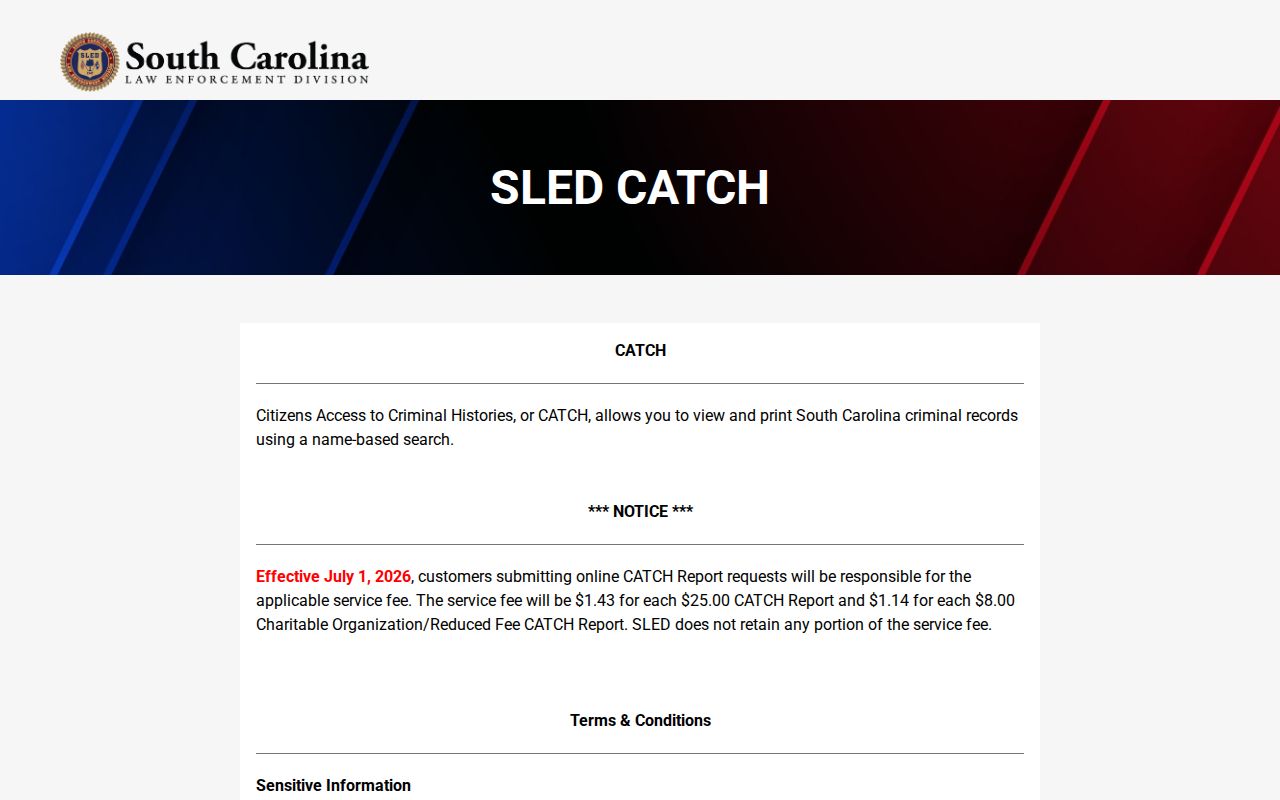
The portal is the public name-check product, not a warrant, registry, national, or certified county-docket search.
How Records Reach SLED
A South Carolina record begins with the source agency. A sheriff, police department, campus department, or state agency creates the incident and arrest report. A detention center adds booking data. Under Section 23-3-120, covered arrest prints and identifying information must reach SLED within three days. The fingerprint transaction creates the arrest cycle to which later data can attach.
Data flow: County Arrest › Fingerprint Submission › South Carolina Law Enforcement Division › Court Disposition Reporting › Rap Sheet
General Sessions clerks, magistrates, and municipal judges report case outcomes under their respective statutes. Current enacted disposition reporting is five days, excluding weekends and holidays. The disposition must connect to the right print-supported arrest cycle. A changed charge may require new prints. Name variations, missing prints, rejected transactions, or a reporting lag can break the link. The county docket can therefore show a prosecution that CATCH misses.
Note: The court outcome must attach to the correct fingerprint-supported arrest cycle before it becomes part of the compiled SLED history.
SLED Criminal History Has Five Segments
South Carolina Regulation 73-21 treats a rap sheet as five linked segments, not one flat list. The identification segment holds the core identity tied to fingerprints. An identification add-on carries added identity facts. The arrest segment records the arrest event and charges. The judicial segment records the court outcome. The custody and supervision segment reflects later correctional or community-supervision data where reported.
- Arrest cycle
- A fingerprint-supported arrest transaction that later court data should match.
- Disposition
- The court's result for a charge, such as conviction, dismissal, acquittal, or nolle prosequi.
- Rap sheet
- An identity-linked history of arrests and reported outcomes, not the full case documents.
This structure explains why an arrest may appear with no result, or why a court case may not appear at all. Each segment comes from a different reporting event. Regulations require audits, correction of material errors, and dissemination logs that retain the requester, subject, items released, date, and source agency for one year.
SLED's 42 Percent Disposition Gap
SLED's FY2025 accountability report measured two key points in the pipeline. Eighty-eight percent of arrest information reached SLED within three days, near a 90 percent target. Only 42 percent of arrests had dispositions attached, far below the 79 percent base or target. A state repository can therefore receive the arrest promptly but still lack the final court result.
The gap changes how a reader should handle an open-looking entry. Do not assume the case is still pending. Search the county docket, then request a certified disposition from the clerk. SLED began audits aimed at missing or rejected prints and unattached outcomes. A certified source document gives the agency what it needs to fix a wrong judicial segment.
Note: An arrest without a listed disposition may reflect reporting lag, not proof that the related county case remains pending.
SLED's Direct-Indictment Fingerprint Gap
A direct indictment may begin with a grand jury rather than a normal arrest and booking. In July 2026, SLED reported that only 7 percent of direct indictments from 2025 forward had reached CCH, mainly because prints were not taken or submitted. That is a narrow but serious limit on the word “statewide.” A county Public Index entry may be the only online trace of a prosecution that lacks a print-supported state cycle.
SLED described portable biometric equipment and training intended to close this gap. The response is tied to CCH redevelopment and county pilot work. It also shows why the South Carolina county directory is part of a sound record review. The county court file and state compilation should be compared, not treated as substitutes.
Ordering a Check From SLED
Choose the channel before gathering personal data. A general South Carolina name search belongs in CATCH or the mail form. An authorized fingerprint check starts with the program that requires it. A review of one's own alleged error starts with a current report and the source court record.
- Select online CATCH, mail CATCH, or the authorized program's fingerprint process.
- Gather the required name, birth date, aliases, and any program form or service code.
- Submit through CATCH, mail the official form with a stamped return envelope, or attend the authorized capture appointment.
- Pay only the posted channel fee and save the report or receipt.
- Compare each reported event with the county court file when full case detail or a certified outcome is needed.
CATCH asks users to choose a requester type. The official SLED requester-type source distinguishes public, account, and statutory paths.
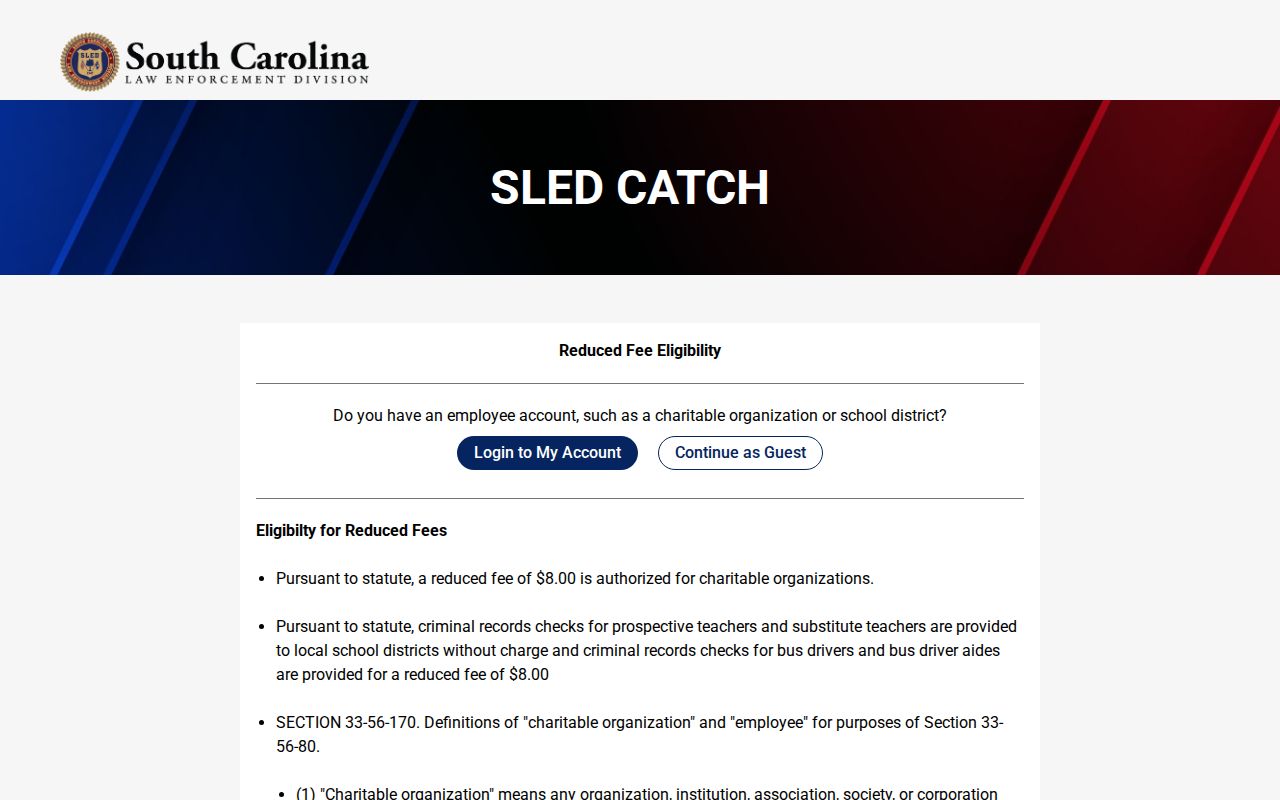
The choice affects the workflow and whether a reduced-fee statutory account can be used.
SLED Guest Reports Expire Quickly
A guest user enters an email address, receives a confirmation code, and uses that code to retrieve the paid CATCH response. The interface says results expire after 72 hours. Save or print the response promptly. Do not place a real email address in a shared screenshot or public link.
The official SLED guest retrieval source shows the email and confirmation-code workflow.
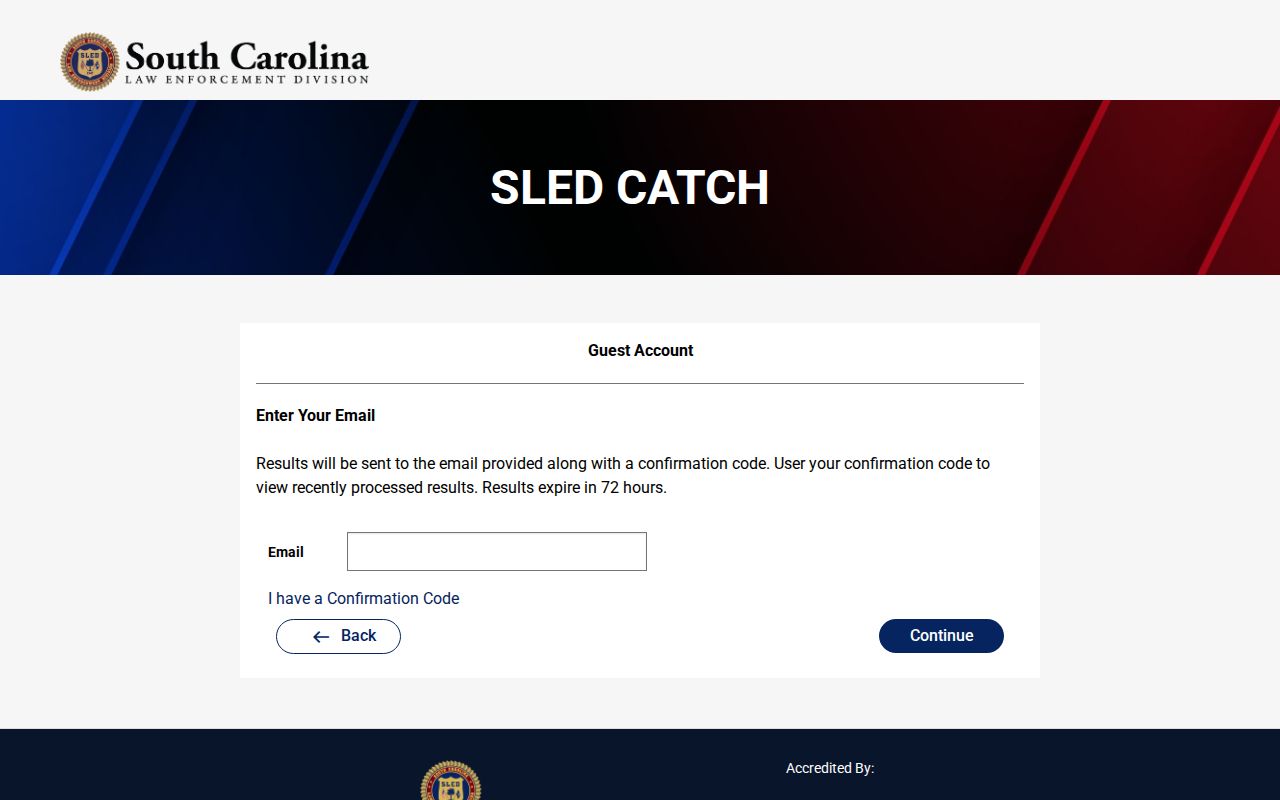
The short retrieval window makes the saved copy important, especially when a later challenge needs the report date and entry details.
Note: Save the paid guest response before the 72-hour retrieval window closes, especially when it may support an error challenge.
SLED Fingerprint Checks Through IdentoGO
IdentoGO by IDEMIA is SLED's exclusive live-scan provider for programs authorized by statute. The authorizing agency supplies the reason code, forms, appointment steps, and recipient. A local agency may roll an ink card, but capture alone does not create authority for SLED to release a fingerprint result. Program scope and charges vary.
Use the official South Carolina IdentoGO source to locate authorized capture services.
The provider page helps find service locations, but the correct service code must still come from the authorized program.
County Records vs SLED Checks
SLED gives one South Carolina compilation. A county holds the original arrest, booking, and court material. The state result can find print-supported events across counties, while the local file may be faster and much richer for one prosecution. Neither source replaces the other.
| SLED Check | County Records | |
|---|---|---|
| Coverage | Fingerprint-supported South Carolina history | One county or court |
| Source | Compiled CCH segments | Original police, jail, and court files |
| Freshness | Depends on print and outcome reporting | Updates as the local event or case moves |
| Detail | Identity, arrest, charge, and reported outcome summary | Reports, docket events, orders, and certified dispositions |
| Best Use | Statewide self-review | Confirming one case and obtaining source documents |
A paid state report can miss an unprinted direct indictment. A free county docket may show it. Conversely, one county search cannot reveal a print-supported event elsewhere in South Carolina. Start broad, then verify locally.
Note: CATCH provides breadth across South Carolina, while the county clerk supplies the certified documents for one prosecution.
Fixing Errors in a SLED Record
South Carolina regulations provide an own-record review and challenge path. Identity errors may require AFIS fingerprints. A wrong or missing outcome requires proof from the originating court. SLED can correct its repository, but it cannot decide whether a case qualifies for expungement or create a court order.
- Obtain a current CATCH report and mark the exact arrest, charge, or outcome believed wrong.
- Get a certified disposition or expungement order from the county court or solicitor that handled the charge.
- Submit the challenge to SLED AFIS or Public Dissemination with the source proof requested.
- Order a fresh report after processing and verify that the corrected segment now appears.
For an expungement order, SLED says to allow four weeks after receipt. If an entry remains, its instructions call for a certified true copy of the order, a CATCH report purchased within the last 30 days, and a stamped return envelope sent to the SLED Expungement Department. Administrative review, review by the CJIS Assistant Director, and appeal to the Criminal History Administrative Appeal Board are available under Regulation 73-24.