
Criminal Court Cases in South Carolina
South Carolina divides criminal court work by the type and weight of the charge. Circuit Court, Court of General Sessions is the main trial court for felonies, indictments, and serious criminal matters in each county. Magistrates' Courts handle summary criminal matters, warrant and preliminary functions, and offenses within their set limits. Municipal Courts hear city ordinance cases and state offenses that fall within municipal summary jurisdiction. Each court keeps its own part of the record.
A General Sessions file is held by the county Clerk of Court. A summary case remains with the Magistrate or Municipal Court that heard it. Appeals from summary courts move to Circuit Court. General Sessions appeals can proceed to the Court of Appeals and then, when review is allowed, to the Supreme Court. The South Carolina Judicial Branch supplies statewide entry points, but local clerks remain the source for certified court records.
Choose the South Carolina Criminal Court
The charge description is the best first clue. A felony, indictment, or serious criminal prosecution generally points to General Sessions. A lower-level or ordinance matter may belong to a Magistrate or Municipal Court. The public index can show a court name and case number, yet it cannot make a legal classification for the reader. South Carolina often ties felony or misdemeanor class to the maximum term in the offense statute, not to one simple letter ladder shown on every docket.
The official image of Magistrate and Municipal Court expungement resources reflects why the court level matters after a case ends.
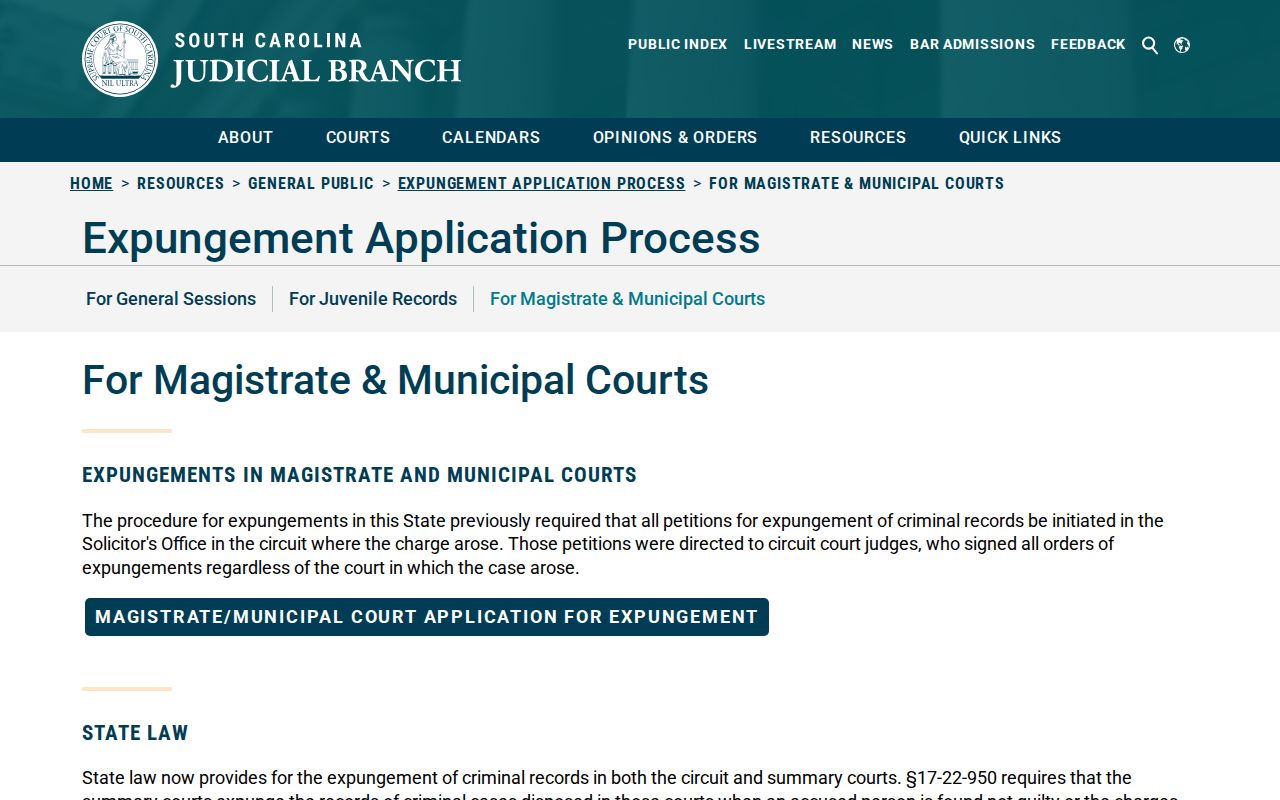
Summary-court forms and procedures differ from the General Sessions path, so the named court on the docket should guide each document request.
Note: A Municipal Court case may not appear unless that court participates in the Judicial Branch selector.
Searching South Carolina Judicial Branch Case Records Search / county Public Index
The Judicial Branch Case Records Search routes users to a Public Index for each South Carolina county and lists participating municipal courts separately. It is a gateway, not one merged docket. Cookies and JavaScript must be enabled, and a pop-up exception may be needed to open case detail. Date depth, document images, and exact filter labels can differ across county deployments.
- Select the county or participating city court where the South Carolina criminal case was filed.
- Search by party name or exact case number, using reasonable name variants when needed.
- Narrow by criminal case type, status, or date when the selected index offers those filters.
- Record the court, case number, charges, events, and disposition without treating a name match as identity proof.
- Ask the proper clerk for the indictment, signed order, sentencing sheet, or certified disposition needed.
| Field Label | Type | Required | Notes |
|---|---|---|---|
| County, City, or ZIP | Search/select | Yes for routing | Opens a county index or listed municipal source |
| Party Name | Text | No | Common county path; use name variants |
| Case Number | Text | No | Best route when the exact number is known |
| Case Type or Status | Filter | No | Labels vary by county deployment |
| Date | Date filter | No | Online coverage varies by court |
Missing South Carolina Municipal Cases
Seeing links for all counties can create the wrong idea that every South Carolina criminal court feeds every case into one place. It does not. The Judicial Branch lists only participating municipal courts. A city prosecution may therefore be absent from the county Public Index even though the municipal clerk has an active or closed file. Older records and documents that were never scanned can also require a direct request.
Start with the incident location and the agency shown on any citation or arrest paperwork. Then identify whether the charge was filed in General Sessions, Magistrates' Court, or Municipal Court. If the online result is blank, contact the likely court rather than concluding that no case exists. South Carolina FOIA governs many agency records, but court access also follows judicial rules, sealing orders, and privacy limits. Juvenile files and expunged matters are not ordinary public case records.
Inside a South Carolina Criminal Case File
A South Carolina case file tracks the prosecution, not merely the arrest. Its header may identify the county, court, case number, filing date, case type, status, and judge. Party entries can name the State, defendant, counsel, and solicitor. Charge rows may show a count, offense or CDR code, statute description, offense date, and final outcome. Event entries build the timeline from warrant or indictment through disposition and appeal.
| Case Number & Court | Identifies the filing and the clerk who holds the official record. |
|---|---|
| Charging Documents | May include a warrant, indictment, information, or complaint. |
| Docket Entries | Chronological filings, hearings, motions, pleas, trial events, and orders. |
| Hearing Dates | Scheduled or completed court events, subject to later change. |
| Disposition | The result of each charge, such as guilty, dismissed, not guilty, or nolle prosequi. |
| Sentence & Judgment | Term, suspended part, probation, fines, restitution, and signed judgment where public. |
The Judicial Branch expungement overview shows the formal path used when an eligible South Carolina record may be cleared.
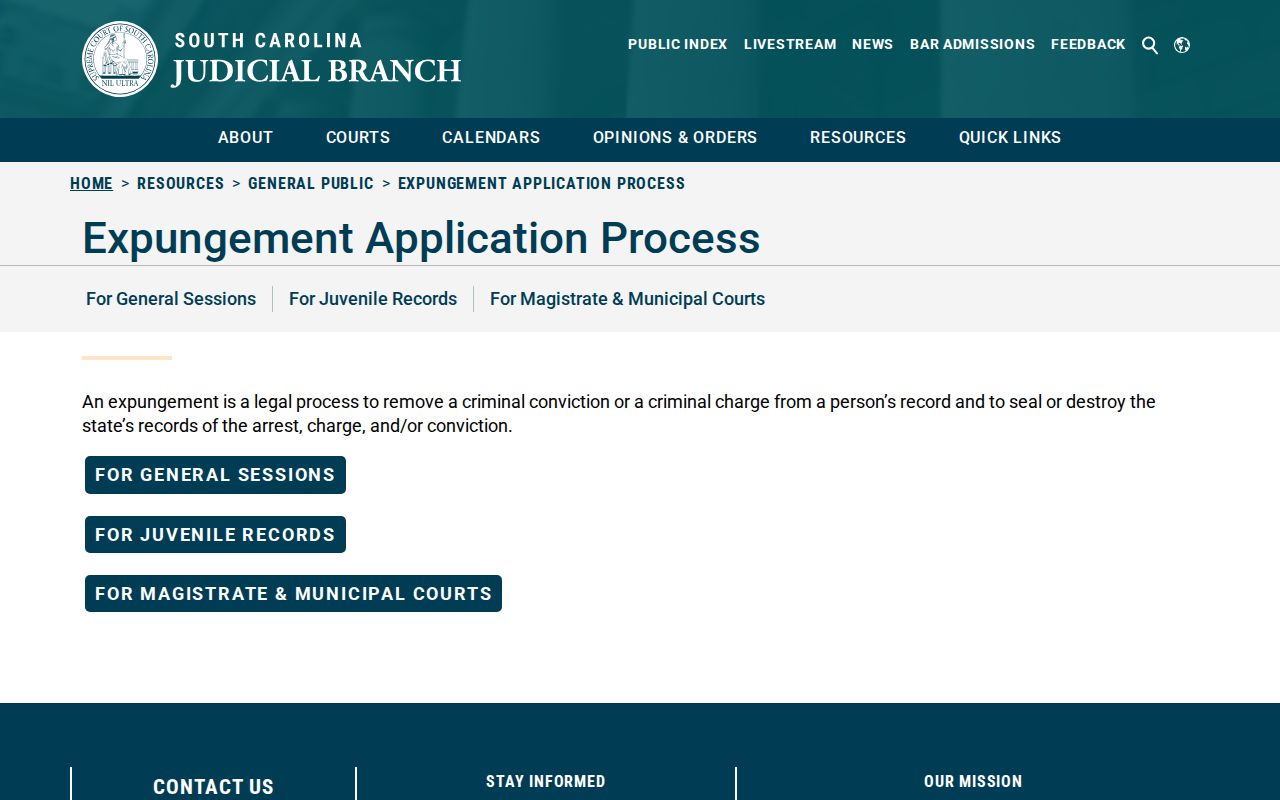
An expungement order comes through the solicitor or court process. SLED implements a valid order but does not decide eligibility.
Note: A public docket is informational; only the clerk can issue the certified file or signed order for a South Carolina case.
South Carolina Criminal Appeals in C-Track
Trial-court searching and appellate searching use different systems. The C-Track public search covers the South Carolina Supreme Court and Court of Appeals. Its fields include court, case title, filed-date range, group, appellate case number, type, and an option to exclude closed cases. A separate participant-search tab offers another route. Filed documents may be available, but the portal warns that it is not the official record.
The official C-Track image shows the separate appellate interface and its search controls.
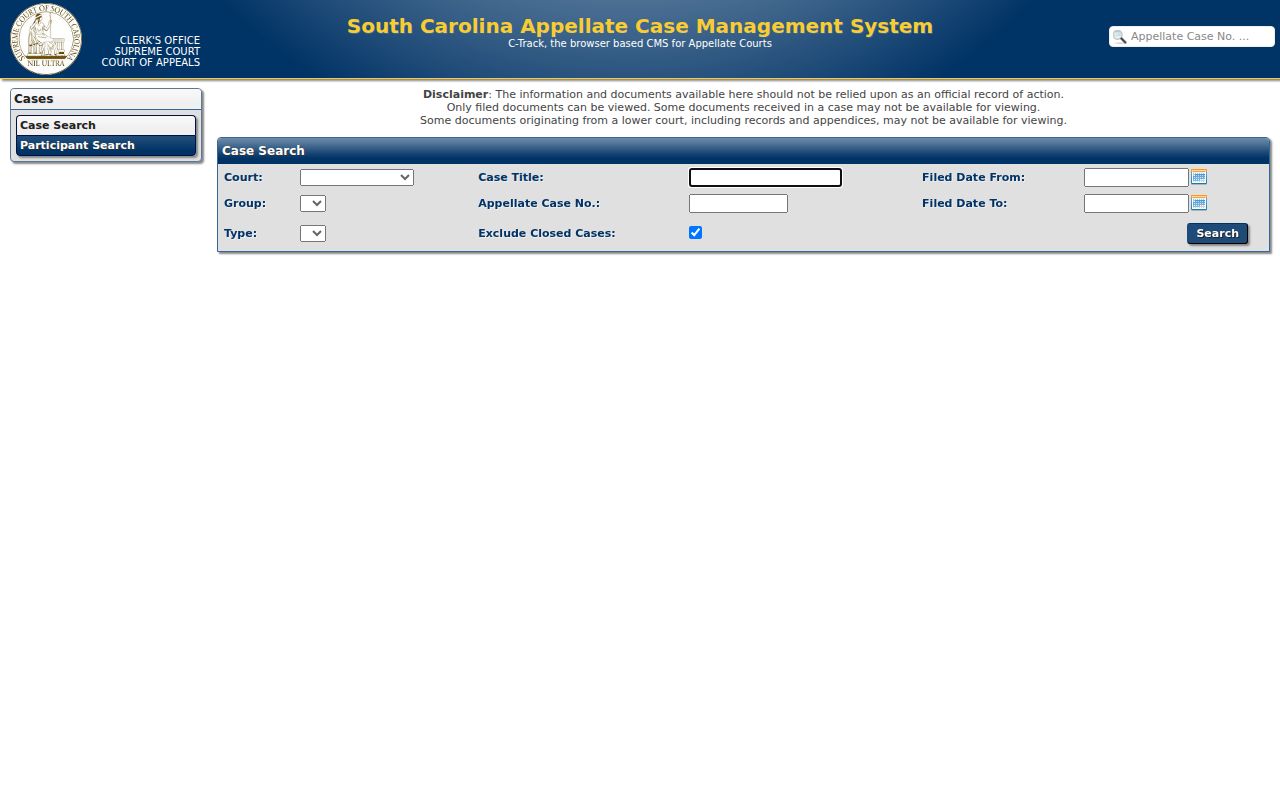
Use the trial case number and party information to check for an appeal, then ask the appellate clerk for an official copy when certification matters.
Note: An appeal creates a new appellate docket but does not replace the county trial file or its judgment.
How a South Carolina Criminal Case Moves
A case can generate several records before it ends. An arrest and booking create agency and jail entries. A warrant, complaint, or indictment begins the court trail. Arraignment presents the charge and may record a plea. Pretrial motions and roster events show how the matter advances. A plea or trial produces an outcome, while sentencing creates the judgment and terms. Each charge can have its own result, so read charge rows instead of relying only on a case-level status.
Case flow: Charges Filed › Arraignment › Pretrial › Plea or Trial › Disposition › Sentencing
A blank disposition should not be read as proof that a South Carolina court case remains pending. Reporting or display can lag. The clerk can confirm the status and provide a certified disposition. Since January 1, 2026, home addresses no longer appear on the public index for new and existing cases, a display change that does not by itself alter the underlying official file.
Read South Carolina Criminal Dispositions
The outcome line answers a different question from the charge line. A charge states the accusation. A disposition states how the court resolved it. South Carolina court records may use terms that are short but carry distinct meanings. Read each one with its date and sentence entry, then obtain the signed order if the precise effect matters.
- Nolle prosequi or nol pros
- The solicitor chose not to continue that charge at that time.
- Dismissed
- The charge ended without a conviction, though expungement may still require a separate process.
- Acquitted
- A not-guilty result after trial.
- Convicted
- Guilt was established by plea or verdict and judgment.
- Remittitur
- The appellate court returned jurisdiction after its decision.
South Carolina law permits qualifying records to be destroyed or removed through specific expungement routes. A pardon is different and does not erase the court or SLED record. If a cleared case still appears, retain the signed order and contact the court or solicitor that issued it.
Case Records at the County Level
The complete General Sessions file stays with the county Clerk of Court where the South Carolina case was filed. A Magistrate or Municipal file stays with that summary court. Online indexes are useful for locating a case number and reading events, but the clerk supplies the indictment, sentencing sheet, signed orders, and certified disposition. Copy and certification charges follow the court's current schedule, so ask for the total before sending payment.
Begin with the county tied to the alleged offense or filing. For example, readers can open the Greenville County records site or the Richland County records site when the case arose there. Browse the full directory of all 46 South Carolina counties to reach the correct local criminal records site. It is safer to verify the court and case number than to infer jurisdiction from a person's current address.
Note: The filing county, not a person's current home county, determines which clerk holds the original criminal case file.
South Carolina Case Files and SLED
A county court file and a SLED CATCH report are related, but they are not the same record. The court file holds the docket, filed papers, amended charges, hearing events, and signed disposition. CATCH compiles fingerprint-supported arrest cycles and reported outcomes across South Carolina. Its strength is identity linking. The county file's strength is detail about one prosecution.
That split matters because reporting is incomplete. SLED reported in July 2026 that only 7 percent of direct indictments from 2025 forward had entered the computerized criminal history repository, mainly because most subjects were not fingerprinted. A South Carolina Public Index case can therefore exist even when CATCH has no matching cycle. Conversely, a CATCH arrest may lack a later disposition if the court outcome did not attach correctly.
The official Circuit Court forms collection illustrates the document channel used for South Carolina General Sessions matters.
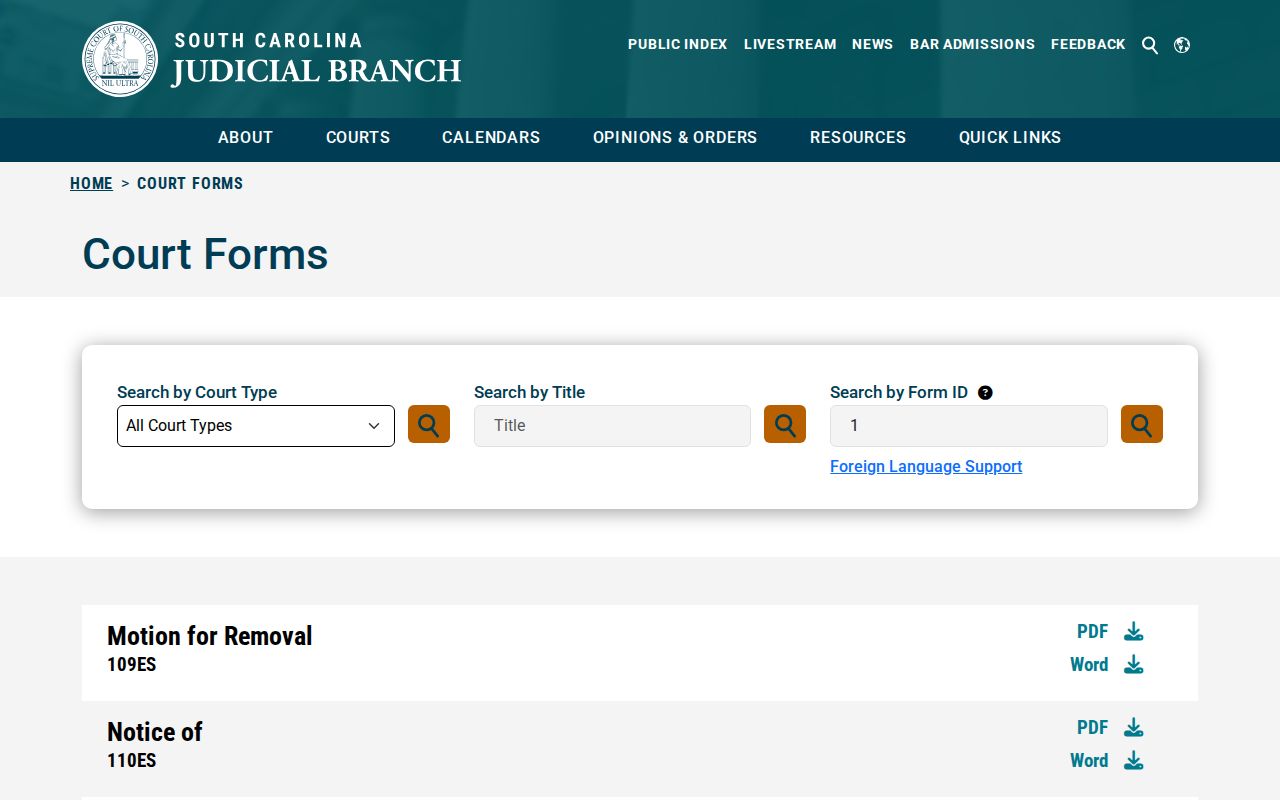
Forms help identify the right filing, while the clerk remains the source for the completed document in a specific case.